Who Gets to Write the Story: Inside Playwrights’ Center’s Fellowship Model
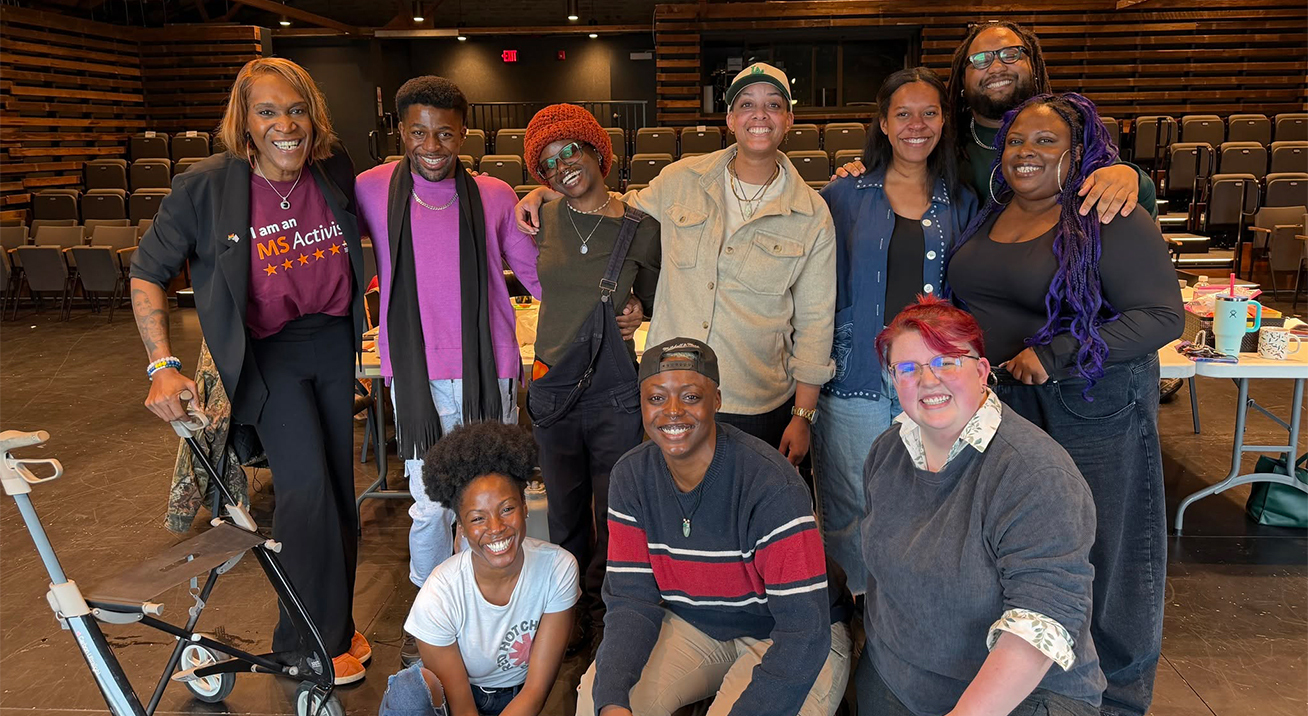
Venturous Playwright Fellow Nissy Aya's workshop group. Photo provided by Playwrights' Center.
American theater has an access problem. For generations, a narrow set of gatekeepers has decided whose stories get workshopped, produced, and paid for, and playwrights of color and LGBTQ+ writers have had to fight for space that should have been theirs. Changing that isn’t just about who’s onstage. It’s about who controls the room where new work gets made.
Playwrights’ Center, based in St. Paul, Minnesota, works to change who holds that control. Through year-long fellowships, workshops, and public readings, the Center gives playwrights from underrepresented communities paid time and professional support: a director, dramaturgs, and actors to fully develop a script that’s production-ready. That’s a different model than waiting to be discovered: the Center builds a writer’s leverage before the industry gets involved.
Venturous Theater Fund, a donor advised fund housed at Tides Foundation, has supported the Playwrights’ Center for many years and has underwritten the Center’s Venturous Playwright Fellowship since 2022, including support this year that helped the Center navigate a disruptive stretch for Twin Cities arts organizations.
We recently sat down with Nicole A. Watson, Producing Artistic Director at Playwrights’ Center, to learn more about how she thinks about power in an industry where a small number of gatekeepers have long decided whose work gets produced.
Nick: Venturous Theater Fund has backed the Venturous Playwright Fellowship since 2022, including support this year during a disruptive stretch for Twin Cities arts organizations. How has that partnership shaped the Center’s programming?
Nicole: Playwrights’ Center has been honored to steward the Venturous Playwright Fellowship. Since I started at the organization in 2024, I’ve seen the Fellowship grow and develop. This partnership is now one of our most robust programs in terms of the funds, time, and additional resources available to a Venturous Playwright Fellow. During a particularly challenging year for the Twin Cities, having a nimble partnership allowed us to respond to the evolving needs of local and out-of-town artists.
Nick: If someone reading this wanted to support playwrights of color and artists from underrepresented communities through Playwrights’ Center, what should they know about what that support makes possible?
Nicole: Playwrights’ Center is first and foremost an artist-service organization. What that means is that all of our resources and advocacy go toward amplifying and stewarding the work of each individual playwriting fellow and their singular artistic voice. At present, we have 40 playwrights on fellowship and over 60% of those playwrights are members of the global majority. Through our different fellowship programs, we can provide one to three years of dedicated support: workshops to develop one’s play, artists and audiences to engage in that development, travel funds, and research funds. Given our selection process, year after year we welcome playwrights who are writing for and to so many different communities. Our work here is not to dictate what story should be told but to effectively nurture the stories a playwright wants to tell.
We are always grateful for our partnerships with foundations, and as we look at the shifts in American theater, our organization is being asked to increase its support for individual playwrights and for new play development.
Nick: How do you think about the Center’s role in shifting power within the American theater industry, beyond any single production?
Nicole: Every year there are more playwrights who apply for fellowships than the number of fellowships we offer, which is always disappointing. I wish we could support more people. At the same time, the Center makes its best efforts to put decision-making power in the hands of other artists. Between the artists who serve as readers or nominators, and the artists who serve on the selection committees, we are not asking any individual theater leader to “anoint” a playwright. Once someone is on fellowship, we do our best to provide resources and advocate for them, and we really try to invite the playwrights to use their fellowship time to write. I don’t know that we’ve truly shifted power within the entire industry, but I believe that we are one of the few places that tries to put that power in the playwright’s hands while they are on fellowship, to write the stories that matter the most to them.
Nick: Who’s in the room when the Center decides which writers and projects to invest in, and how do you make sure that reflects the communities you’re trying to reach?
Nicole: First, all of our fellows are ultimately selected by a panel of artists that changes every year — staff of the Playwrights’ Center and I do not decide who is the recipient of a fellowship.
Second, once a playwright is on fellowship, we ask what they are interested in doing, since we’re not commissioning a specific play from them. We want playwrights to be the architects of their own fellowship, with a say in how their development funds are used and what programming we create around them year after year.
Because of the nature of our programs, the communities we’re trying to reach change depending on who is on fellowship. But I believe Playwrights’ Center is uniquely positioned to help develop an audience of new play lovers: people invested in hearing a variety of stories, often the first to hear a play that may end up on stages across the country. Playwrights and their new plays are an invitation for community gathering and conversation.
Nick: Your equity value talks about building systems that center meaningful financial compensation. What does that look like in practice for writers coming through the Center?
Nicole: We. Pay. People. For. Their. Work. Playwrights are compensated for their time in rehearsal. Actors, directors, designers, are compensated for their time. We pay our teachers, many of whom are playwrights in the field. We really try to avoid asking anyone to volunteer. We set aside additional funds for childcare or other family care, and travel funds to meet accessibility needs. At the same time, many of our public events are free, so as a nonprofit, the delicate dance is how we provide economic accessibility while still providing appropriate compensation year after year.
Nick: What’s next for Playwrights’ Center, and what would you want people to know about where it’s headed?
Nicole: I started my tenure at Playwrights’ Center in April 2024, in the middle of a capital campaign and a construction project to build a new home for the organization in St. Paul, Minnesota. We opened our new building in fall of 2025, in the middle of a difficult year of political upheaval and loss of national funding.
Even amid these challenges, Playwrights’ Center is finding exciting ways to expand and enhance the experience of the playwrights we support, building new partnerships with national and local arts organizations that want to advance and amplify individual artists and celebrate new plays, and thinking strategically about what it means to be one of the only year-round incubators for new play development in the country.
If you are a playwright, we will be launching applications for our next cohort of fellows soon, and we are also offering a number of exciting classes and seminars. In the long run, we want to be able to expand the number of playwrights who are on fellowship with us and continue to try to build pathways to sustain a career in the theater. We have some big announcements coming later this year, so visit our website to learn more.