The People are the Engine: Southern Leaders on Environmental Justice and Democracy
Seven Southern movement leaders shared what's at stake, and what philanthropy needs to hear.
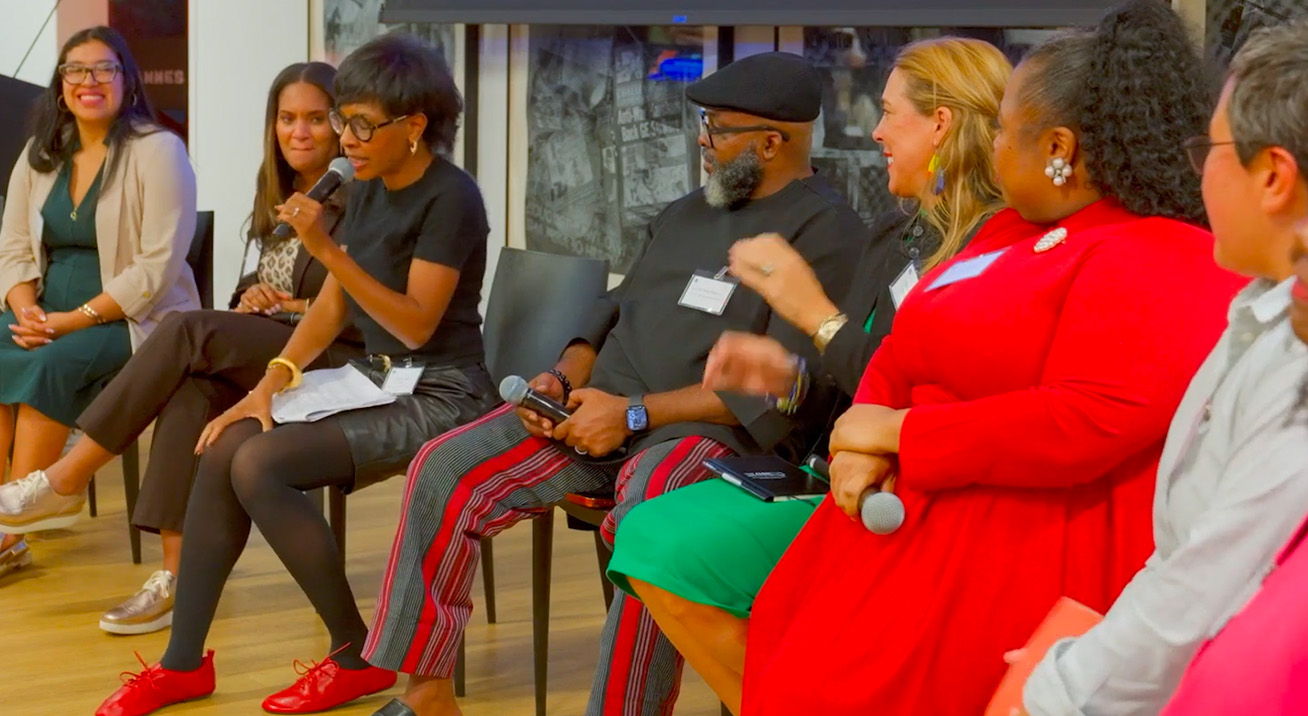
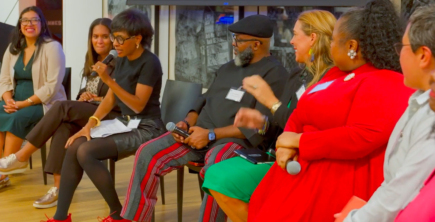
Livable Futures panel at Climate Week NYC 2026.
In the South, the fight for clean air, clean water and affordable power is also a fight over who gets a say. During Climate Week NYC in September, seven leaders organizing across Alabama, Florida, Georgia, Louisiana, Tennessee and Texas came together for a conversation about building a more just and sustainable South. Titled “Livable Futures: Environmental Justice and Democracy in the South,” the event was hosted by Tides in partnership with The New School’s Tishman Environment and Design Center.
The evening brought together partners of three Tides initiatives: the Women’s Environmental Leadership Fund (WE LEAD), the Frontline Justice Fund and the Healthy Democracy Fund.
Together, Yadira Sanchez (Poder Latinx), Ashley Shelton (Power Coalition for Equity and Justice), Rev. Michael Malcom (The People’s Justice Council), Yoca Arditi-Rocha (The CLEO Institute), LaTricea Adams (Young, Gifted & Green), Frances Valdez (Houston in Action) and Abre’ Conner (NAACP) discussed how climate and democracy connect in their communities. Tareya Palmer, program officer for the Healthy Democracy Fund, moderated the conversation.
Their message was direct. Southern communities already have the strategy, the relationships and the courage to win. They need resources that move at the scale and speed of the threat. Watch the video and read selections from their conversation below.
What’s at Stake for Environmental Justice in the South
YADIRA SANCHEZ: Right now, one of the most pressing issues that we have in our community is energy affordability…. The temperatures continue to rise and in some of our states, the AC is not a luxury, it’s a necessity. People need their AC in order to survive, especially folks with medical conditions. So that has been constantly the issue that is economic, that is also health related and of course climate related, because we need clean energy. Latino communities care deeply about the environment.
REV. MICHAEL MALCOM: I would say that our biggest issue is affordability. This is compounded by data centers. This is compounded by the climate crisis. This is compounded by racism, sexism, xenophobia…. It’s all compounding the fact that we can’t afford to live the way that we live right now. And that is the conversation that we are having in our homes.
YOCA ARDITI-ROCHA: At the intersection of climate and democracy in Florida is the investor-owned utilities and their monopolies. Right now, 75% of our power comes from IOUs…. The state regulator, the Public Service Commission, is appointed by the governor, not elected as in other states…. We recently released an investigative report on utility accountability where we found that $80 million were spent on political contributions in the last two election cycles. So if we’re talking about democracy and we’re talking about climate change, at the core of that are IOUs.
FRANCES VALDEZ: I’m going to be real, what comes up for me is our people are dying. In Houston, the hurricanes have been getting worse my whole life. The flooding has been getting worse. And we now have winter storms…. My grandmother died during Winter Storm Uri…. After a lot of my grief, I realized, no, but you survived 96 years of them trying to kill you. And that’s the strength that people are talking about on this panel, of what we come from.
Data Centers and the Fight for Fair Representation
ASHLEY SHELTON: At the core of so many issues is representation…. In a state that has the second largest Black population proportionally, we have been trying to make sure that we could have representation…. When you don’t have fair representation, then you can’t fight a fair fight…. SpaceX is in Pecan Island, which is like Sportsman’s Paradise. Everything you ever loved about Louisiana is right there in that community. And now it’s all threatened and nobody saw it coming. Nobody asked them.
LATRICEA ADAMS: The biggest thing that we’re fighting with right now is actually an attack on democracy. That definitely is at the intersection of the proliferation of data centers, but even bigger than that is how data centers ended up in our community…. We didn’t even have an opportunity for the people that we selected on our ballot to even say yes or no. Not with city council, not with land use, not with zoning…. A lot of people didn’t think that these Black folks in Memphis, Tennessee, would have the capacity and the know-how to push back, but we did…. It was in Memphis that MLK took his last breath. So with that same energy from my ancestors, we will continue to resist.
REV. MICHAEL MALCOM: It’s more than just a Black and white thing. It’s more than just a haves and have-nots thing. This is a collective assault on our society. Project Marvel in Bessemer, Alabama, is one of the examples…. This site is set to be one of the largest data centers in the United States of America. Eighteen Super Walmarts…. It affects all of us in Jefferson County. So it’s all of our fight.
ABRE’ CONNER: We’re seeing a lot of that continue to show up in the data center discussion…. From places like Jackson, where they were fighting for almost a century to have access to their actual water systems, to Memphis, where you have the sanitation workers who were fighting for just transition, for jobs and for clean air. This is not necessarily new. But what we’re seeing is these tech oligarchs saying that we want to maintain the power system as it existed for many years.
What Funders Still Don’t Understand About Climate and Democracy
REV. MICHAEL MALCOM: Conversations happen in our homes…. You can’t talk to organizational heads, particularly national organizations, and think you’re hearing what’s happening in folks’ homes. You’ve got to invest in the people that are going to those people’s homes and having conversations…. Our pain and our plight aren’t trends. You cannot move away from them and think that it’s going to automatically solve itself…. We need y’all to get to the table, and get to the table in a hurry, because we’ve already lost enough ground.
ASHLEY SHELTON: It kind of felt like we had a pretty car, but we didn’t have an engine. And the people are the engine…. [Philanthropy is] more than happy to give $1,000,000 for the policy report and the advocacy and analysis, and then you want to give me 100 grand to go tell community what to do with the information in the toolkit. It costs so much more money to move people, to educate people, to build the kind of relationships that create the kind of trust where power actually can be built.
YOCA ARDITI-ROCHA: Delay has a cost. And with capital delays, our communities suffer. Point blank…. If we want climate wins and we want climate solutions and we want a healthy democracy, we need to invest in movement infrastructure. And that takes years of movement building…. Sometimes these wins are small and incremental, and we continue to move and move and build and build.
LATRICEA ADAMS: Trust the South…. Respectfully, we don’t need philanthropy to do trainings with us. I came from a legacy of organizers…. It’s in my DNA to resist…. We are nickel and diming our way through winning.
ABRE’ CONNER: Oftentimes when people are saying that they’re funding legal strategy, they start with just the lawsuit itself without understanding how much work it takes to actually get to the lawsuit. It’s organizing. It’s technical assistance. It’s public education…. That takes years and years of effort…. It’s okay to have new things, but we also have to fund what we already have. The infrastructure is already there, particularly the infrastructure that is Black, Indigenous, Latin and people of color led.
Courage Is Already in the Room
FRANCES VALDEZ: I’ve learned a lot in the last couple years about how the people with the most money have the least amount of courage. And that is why what we’re talking about on this panel… what is in the South are people with so much courage, y’all. So much courage, so much love for their communities…. People are dying. So we might need to make some people uncomfortable…. These folks have the courage. So if you need it, hang out with these folks as much as you can. Seriously, it’s contagious…. Please nurture our courageous leaders.
REV. MICHAEL MALCOM: We can’t plan ourselves out of this moment right now. We can’t listen ourselves out of this moment right now…. Now is the time to act and move.
This conversation has been edited for length and clarity.
The leaders on this panel are building livable futures across the South right now. Learn more about the Women’s Environmental Leadership Fund (WE LEAD), the Frontline Justice Fund and the Healthy Democracy Fund, and sign up emails from Tides to follow their work.