Frontline Justice Fund

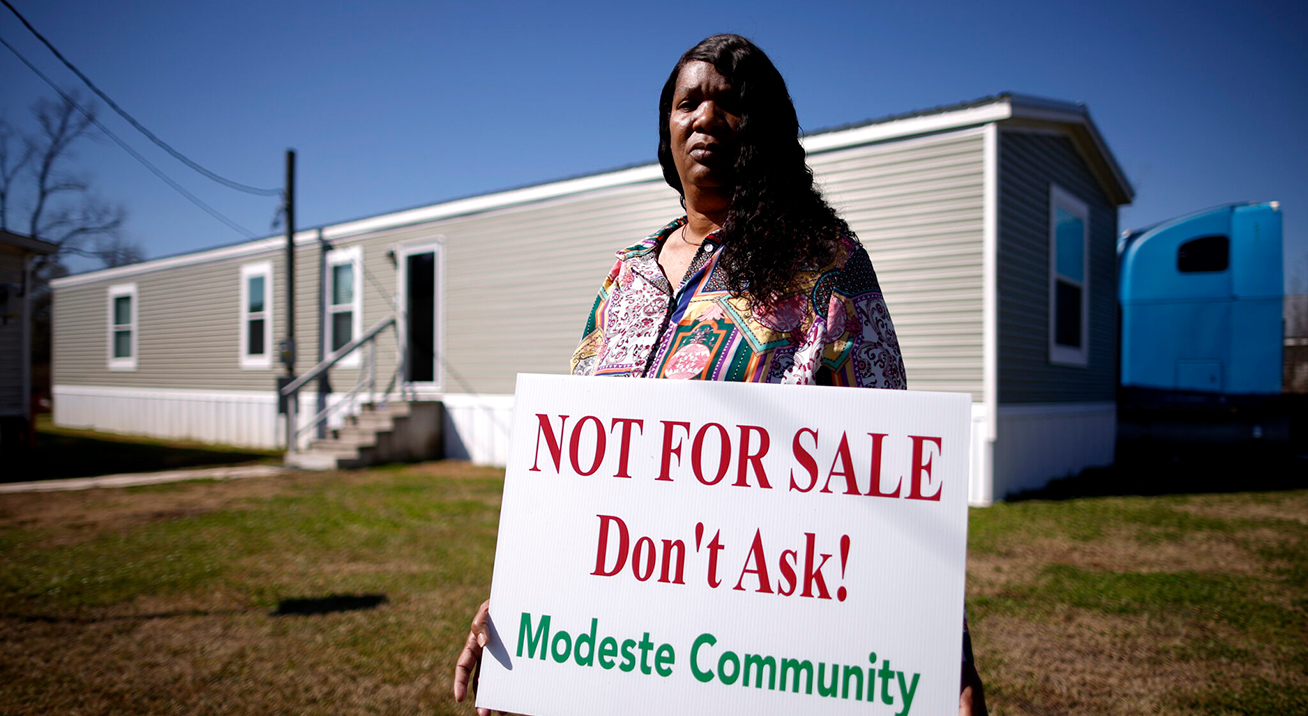
Twila Collins, a Modeste community member in Ascension Parish. Photo by Sean Gardner for Floodlight.
Environmental justice in Cancer Alley has never been just about pollution. It’s about who gets informed, who gets to decide, and whose land and whose ancestors are treated as expendable in the name of economic growth.
In Louisiana’s West Ascension Parish, the Black community of Modeste has lived along the Mississippi River for generations, tracing its roots back to the plantations that once occupied the land. Today, a proposed 17,000-acre industrial complex called the RiverPlex MegaPark threatens to displace residents, deepen pollution along Cancer Alley, and disturb burial grounds where enslaved people are laid to rest, all while state and local officials negotiated the deal behind closed doors. Cancer Alley is an 85-mile corridor between Baton Rouge and New Orleans named for its dense concentration of chemical plants, oil refineries, and heavy industry. Hyundai’s steel plant anchors the MegaPark. It’s the first and furthest along of several planned facilities, which also include an ExxonMobil plant, a gas-fired power plant, and carbon capture pipelines.

Ashley Gaignard, President of Rural Roots Louisiana (left), and Anne Rolfes, Director of Louisiana Bucket Brigade
Modeste is responding on two fronts at once. Residents are organizing block by block, and two Tides partners, Rural Roots Louisiana and Louisiana Bucket Brigade, have filed eight lawsuits demanding transparency, accountability, and a say in what happens to their own community. We spoke with Ashley Gaignard, president of Rural Roots Louisiana, and Anne Rolfes, director of Louisiana Bucket Brigade, about how organizing and litigation are working together, and what’s at stake.
For Gaignard, Modeste is personal. Her husband’s family includes Leonard Julien, who invented a mechanized sugar cane planter that revolutionized the industry. Neighbors trace their land back to relatives who worked those same fields, some enslaved, some freed, and later generations who turned that history into a community, building the churches, ballfields, and gathering places that residents grew up in.
“When you pass land down like that, you’re not only passing down land, you’re connecting your younger generation to their ancestors,” Gaignard said. She described watching a cabin near her family’s land, where enslaved people once lived, torn down without ever being offered to any of the historical organizations working nearby, which could have preserved it. Losing Modeste, she said, would mean losing far more than acreage: family connections tying people to the land, burial grounds, and a cultural history that “can’t simply be rebuilt anywhere.”
And Rolfes pushed back on the idea that Modeste is a place with nothing left to lose. The community has seen decades of disinvestment: neglected roads, no streetlights, a closed post office. That neglect has been mistaken for decline, she said, when the same public resources now flowing to Hyundai could have built a very different future: a museum honoring local inventors, restored ballfields, and a walking trail along one of the most scenic bends in the Mississippi.
Gaignard first learned about the RiverPlex MegaPark when it was announced by the White House. Months later, in June 2025, a sign staked in the mud was the only public notice residents received.
Rolfes described what that sign was actually announcing. The stretch of riverbank Modeste sits on carried the parish’s most protective conservation zoning classification because of the wetlands there and the ecological weight they carry for the wider region. It’s a bend in the river where bald eagles still nest, she said, and where the evening light falls in a way she struggles to describe. That single sign in the mud was the only notice anyone got that their homes were being rezoned out of that protection entirely. “Practically overnight, they’re going to go from the most protected status to the most vulnerable, which is heavy industrial,” Rolfes said. No direct communication with Modeste residents marked the change, and no step in between softened it.
That pattern, Gaignard said, is what Louisiana calls “fast-tracking,” a process designed to move projects forward before residents have time to organize a response. Buyout offers, she said, went to wealthier landowners with the most acreage, not to the families who have lived on the land the longest. “Our future is projected, not protected,” she said.
The RiverPlex MegaPark’s scope goes well beyond the Hyundai steel plant anchoring it. Rolfes described plans for an ExxonMobil facility, a 2.7 gigawatt gas-fired power plant, and multiple carbon capture pipelines layered on top of it. “If you’re concerned about pollution, petrochemicals, or carbon capture,” she said, “you should be concerned about the RiverPlex.”
The two organizations, represented by the Center for Constitutional Rights, have filed eight lawsuits to stop the project, including three filed in a single day. Two of those three center on Hyundai, the complex’s anchor tenant, and the third reaches the broader RiverPlex site. One challenges Louisiana Economic Development’s cooperative endeavor agreement with Hyundai for failing to provide required public notice and failing to bring the agreement before the state Bond Commission for approval. A second challenges the Port of South Louisiana over a $400 million bond issued for a dock serving Hyundai’s facility, also without the legally required public notice. A third challenges the U.S. Army Corps of Engineers over permits for ground-disturbing construction that could affect unmarked burial grounds, without the meaningful consultation descendant communities are asking for.
The financial details, once the organizations dug into them, were striking. Louisiana committed more than $100 million toward construction of Hyundai’s facility, bought $91 million worth of land that Hyundai can purchase back for $99 after 32 years, and pledged more than $200 million for a rail overpass and highway, on top of extensive tax exemptions. Twenty-three officials signed nondisclosure agreements while the deal was negotiated. Days before this interview, the organizations learned of a previously unknown state body preparing to approve a $900 million bond for Hyundai’s benefit, with only four days of public notice.
“There’s no doubt this is a David and Goliath fight,” Rolfes said. “But we’ve got a slingshot.”
Gaignard is precise about what each organization brings to the table. Louisiana Bucket Brigade, in her words, brought two decades of experience analyzing policy, filing public records requests, and applying financial and legal expertise to complex deals like this one, expertise that helped uncover exactly how much public money was moving toward a single corporation. Rural Roots Louisiana brought something no legal strategy can replace: standing in the community itself. “I’m not just someone with a connection to the community,” Gaignard said. “I’m part of the affected community.”
That combination showed up clearly during Hyundai’s groundbreaking ceremony. Rather than staging a roadside protest along a narrow, dangerous shoulder, Rural Roots Louisiana and Louisiana Bucket Brigade coordinated a small plane carrying a banner over the event, timed with a mobile billboard positioned along the motorcade route, adjusting both plans within hours as new information came in from residents living closest to the site. “It gave us all a real lift, in a way that’s really crucial in these battles,” Rolfes said.
Before taking legal action, Rural Roots Louisiana surveyed residents directly affected by the project, wanting the community to know it was being listened to before any decisions were made on its behalf. Neither organization treats litigation as sufficient on its own. “Litigation is only one piece of a broader community strategy,” Gaignard said. Court wins bring attention and draw in residents who had not been paying close attention, she said, but the deeper work is organizing block by block and building relationships that outlast any single case.
For Gaignard, a legal win means government agencies following the law: proper public notice, lawful approval of financial commitments, and meaningful consultation with descendant communities before decisions are made, not after. But the deeper goal is self-determination. “Nothing about us should be decided without us,” she said.
Sustaining that fight requires resources smaller frontline organizations rarely have access to on their own, from legal and communications support to safe meeting spaces after public buildings were effectively closed off to them. Grants from Tides Foundation donors, through the Women’s Environmental Leadership (WE LEAD) Fund and the Frontline Justice Fund, have helped cover community organizing and communications costs and the sustained research capacity that helped Rural Roots Louisiana and Louisiana Bucket Brigade uncover the financial details behind the Hyundai deal in the first place.
“We are survivors,” Gaignard said. “We stand here.” Modeste’s fight is far from over, but its message to other frontline communities is clear: transparency, legal expertise, and community organizing are strongest when they move together, and no single organization has to take on a fight this size alone.
Fights like this one only happen because someone funds the years of document review, litigation, and organizing before a single headline runs. Give to the WE LEAD Fund or the Frontline Justice Fund to support frontline organizing and litigation capacity like this nationwide.
Photo by Sean Gardner for Floodlight. The photo originally appeared in “Louisiana bets big on ‘blue ammonia.’ Communities along Cancer Alley brace for the cost.” by Ames Alexander. Floodlight is a nonprofit newsroom that investigates the powers stalling climate action.
Frontline Justice Fund

Healthy Democracy Fund

Read the stories and hear the voices of social change leaders fighting for justice.