How The Movement Cooperative Is Building Shared Infrastructure for Organizing
The Movement Cooperative, a single entity fund at Tides.
As movements navigate increasingly complex political and technological landscapes, a growing number of organizations are asking the same question: what does it take to build durable movement infrastructure without duplicating costs, labor, or expertise across the ecosystem? The Movement Cooperative (TMC) is advancing one answer through a model rooted in shared governance, collective investment, and long-term stewardship of movement-owned technology.
Through its member-led cooperative structure, TMC brings together more than 90 national and state-based organizations, alongside a broader network of over 1,400 affiliates, to co-create and sustain the data and technology infrastructure that powers organizing nationwide. This shared approach expands access to critical tools, deepens alignment across partners, and enables organizations to focus their energy where it matters most: strategy, relationships, and community impact.
With fiscal sponsorship through Tides Foundation, structured under Model C (also called a single entity fund at Tides), TMC combines operational independence with deep alignment around shared movement values. This structure creates opportunities for innovation, mutual learning, and cross-organizational collaboration — strengthening the collective infrastructure that supports long-term organizing efforts.
We spoke with Julia Barnes, Chief Executive Officer at The Movement Cooperative, to learn more about the organization’s theory of change, the role of shared infrastructure in building durable movement capacity, and what it means to design technology in service of collective impact.
PAOLA: Julia, we’d love to know what inspired the creation of The Movement Cooperative, and what gap were you hoping to address within the movement ecosystem?
JULIA: We were founded in 2017, when many people were newly energized and looking for ways to strengthen civic life in their communities. Our 12 founding members got together to imagine what it would look like if movement organizations didn’t have to scramble for access to essential data and tech resources. Over the last eight years, we’ve evolved into the power plant for movement tech and an incubator for organizing innovation. We’ve become a hub for experts within the movement to push the envelope on what’s possible for organizing work when we unite long-term vision for community power with tech sophistication that used to be outside folks’ reach.
The gaps we’re filling aren’t just technical, they’re also social and cultural. We cultivate member spaces where staff from movement organizations can exchange questions and ideas, get advice on using a tool, and share insights into what’s working in their grassroots fundraising or leadership development programs. There’s a parallel for TMC between building data infrastructure to get tools to talk to one another and creating opportunities for folks doing essential, under-celebrated work to build community together.
PAOLA: TMC operates through a member-led cooperative model. How does that structure shape decision-making and accountability in practice?
JULIA: Our members steer the ship. We have an Executive Board of Directors and a Technical Advisory Board — both elected and appointed by our members — plus a body of voting delegates, one from every national and state-based member organization. Between that representation and the universal ability for members to propose resolutions during our governance convenings, we’re really putting the organizers closest to the most impacted communities in the driver’s seat.
In 2021, our members voted for TMC to prioritize investments in values-aligned and nonprofit technology, and we’ve pursued that mandate in multiple ways. One, by upgrading TMC’s data warehouse, Haven, and expanding the range of data products we provide to deliver more accurate, more specialized data. Two, we’ve continued to build partnerships with vendors who share our members’ commitment to community-led change.
In 2025, at the urging of our members, we launched a dedicated search for a next-generation voter-contact database, the system organizers use to manage and track their outreach to voters, and ran pilot programs for members to test different platforms. The result has seen us partner with new technologies and deepen our conversation with legacy tech about where organizers want to see them innovate.
PAOLA: Many organizations struggle with the cost and complexity of data and technology infrastructure. How does TMC’s shared model help address those challenges?
JULIA: Integrated technology and lower costs go hand in hand. When members access our database, they’re getting more than just access — they’re also benefiting from built-in data integrations and advanced data security infrastructure. Managed independently, enterprise-grade data security on its own can cost more than four times a TMC member’s average annual membership dues.
By pooling resources, we make it easier for more organizations to securely maintain their data at a fraction of the cost. So rather than having to navigate the database procurement, set it up, staff an engineering team, build data pipelines, and construct security systems, a TMC member can remain focused on their core mission, knowing we’ve handled the rest. Now multiply that time and money saved across hundreds of organizations.
TMC negotiates with vendors to provide more affordable tool rates for all our members — many organizations speaking with one voice generates results for the whole community. Through our collective bargaining and resource pooling, members end up paying hundreds of thousands of dollars less for tools and technology support than an organization going it alone. That kind of savings can instead be invested in programs, organizing, training, and leadership development by our members.
PAOLA: Your theory of change emphasizes collaboration over competition.
Why is that approach especially important in this political and organizing moment?
 JULIA: People are their most powerful when they’re connected. When folks feel overwhelmed, isolated, or powerless, communities lose their voice. Solidarity and showing up for one another are how communities build and keep their power.
Movement organizations shouldn’t be in competition with one another. We should seek to amplify one another’s strengths and pass the mic when someone else should be in the lead. We can achieve so much when we work together: some of the largest coordinated organizing efforts in recent years have only been possible because hundreds of national and local groups, many of them TMC members, were collaborating behind the scenes on event planning, recruiting attendees, and logistics, with TMC infrastructure powering that coordination and data.
Collaboration isn’t just for boosting scale; it also creates opportunities to build deeper relationships and trust in one another. Robocalls and impersonal fundraising texts from people you’ve never heard of make you feel like a faceless, nameless number. But a conversation with a neighbor who’s concerned about utility costs grounds civic action in community and empowers individuals to work for the greater good. Building something people can be part of, bigger than themselves, is key to ensuring activists feel cared for and preventing activism from burning people out.
PAOLA: As technology rapidly evolves, how is TMC thinking about adaptability, sustainability, and long-term movement resilience?
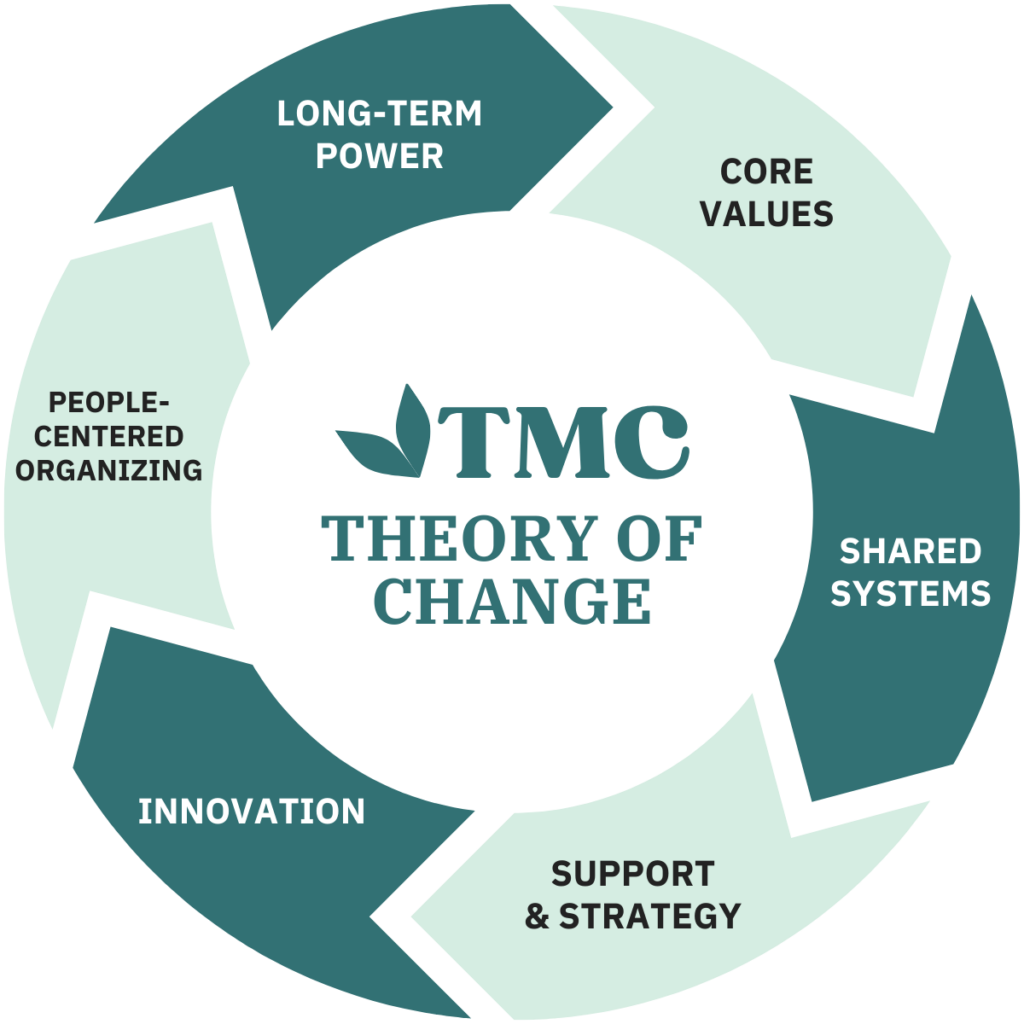
JULIA: Integrated, equity-centered, movement-owned technology should be the norm — because it’s what will power the coordination required for sustainable, long-term change. And for that, we need to reach a shared understanding of what “infrastructure” means in a movement context.
It’s hard to engage folks when you’re talking about big systems in the abstract, but people understand feelings and impact. When folks are worried about AI data centers jacking up electricity costs, they’re not thinking about how everyone gets to the town hall meeting — but they know how it feels when there’s a room packed full of their neighbors speaking up against corporate developers.
TMC fills a crucial infrastructure gap in making that possible by providing the infrastructure organizers can use to turn folks out, get them in t-shirts, and text them the next day to say, “It was great to see you yesterday! Can you make the next meeting in two weeks?”
Infrastructure is what helps organizers do the work with less friction — from door-knock, to t-shirt size, to follow-up text. In the long term, we want to help even more movement organizations experiment, identify winning strategies, and develop leaders and organizations into real foundations of power. We have to take what we are learning cycle after cycle and build shared systems that grow as we grow.
PAOLA: How has TMC’s fiscal sponsorship through Tides supported or strengthened the organization’s growth and work?
JULIA: TMC’s cooperative model works. Our members are bought in. But our members are also nonprofit organizations. Anyone in this field has seen how challenging the fundraising environment has become. Shifts in the funding landscape, the elimination of grants, rising costs, and general economic distress have had real impacts on our members. When our members lose funding, TMC is impacted downstream, while also swimming in the same turbulent waters.
Tides Foundation’s support receiving and overseeing contributions streamlines our fundraising and helps ensure not only that we can close the gap between our membership dues and our programmatic spending, but that we can continue to improve the data and services we provide to our members. TMC’s central location at the hub of our membership organizations means that when we can streamline our fundraising, the investment ripples out into our members.
We’ve grown from 12 founding organizations to over 90 today in part because of the support we receive from Tides Foundation — it’s an essential part of how we can both meet our obligations to members and continue to push the envelope alongside them.